J Educ Community Health. 12(2):93-99.
doi: 10.34172/jech.3387
Original Article
Determinants of Skin Cancer Prevention Behaviors Among Iranian People Aged Over 20 Years Old in Northeast Iran: An Application of the Extended Parallel Process Model
Mitra Dogonchi Conceptualization, Funding acquisition, Investigation, Methodology, Project administration, Resources, Supervision, Validation, Visualization, Writing – original draft, Writing – review & editing, 1, * 
Fatemeh Mohammadzadeh Formal analysis, Methodology, Software, Writing – review & editing, 2
Mahdi Moshki Conceptualization, Project administration, 3
Aida Ahmadpour Data curation, 4
Homa Alizadeh Data curation, 4
Reyhaneh Norizadeh Data curation, 5
Author information:
1Department of Health Education and Health Promotion, Faculty of Health, Social Development and Health Promotion Research Center, Gonabad University of Medical Sciences, Gonabad, Khorasan Razavi, Iran
2Department of Epidemiology and Biostatistics, Faculty of Health, Social Development and Health Promotion Research Center, Gonabad University of Medical Sciences, Gonabad, Khorasan Razavi, Iran
3Department of Health Education and Health Promotion, Faculty of Health, Social Determinants of Health Research Center, Gonabad University of Medical Sciences, Iran
4Department of Public Health, Faculty of Health, Gonabad University of Medical Sciences, Gonabad, Khorasan Razavi, Iran
5Department of Public Health, Faculty of Midwifery, Gonabad University of Medical Sciences, Gonabad, Khorasan Razavi, Iran
Abstract
Background: Understanding factors that influence the adoption of preventive measures to reduce the risk of skin cancer is essential for creating effective educational programs. This study aimed to identify key factors contributing to the adoption of skin cancer prevention behaviors among Iranians in the northeast region of Iran over 20 years, utilizing the extended parallel process model (EPPM).
Methods: Overall, 500 participants were selected using stratified random sampling and included in this cross-sectional study. The data were collected through a researcher-made questionnaire based on the EPPM and a demographic questionnaire. The collected data were analyzed using hierarchical linear regression models in SPSS 16.0.
Results: The median age of the participants was 29.00 years (1st quartile: 22.00 years, 3rd quartile: 41.00 years), with 317 individuals (63.4%) identifying as female. Only 21.8% of participants (95% confidence interval: 18.3%–25.7%) reported consistently adhering to all recommended skin cancer preventive behaviors. Pearson’s correlation coefficient indicated a positive and significant correlation between all the EPPM and preventive behavior, except for defensive avoidance constructs. Furthermore, regression analysis identified gender and four components of the EPPM—perceived response efficacy, fear, perceived self-efficacy, and perceived severity—as the most significant predictors of intentions and behaviors related to skin cancer prevention.
Conclusion: The findings showed a low level of preventive behaviors among the participants and the determinant role of four constructs of the EPPM in adhering to skin cancer preventive behaviors. Therefore, educational interventions based on the EPPM model are suitable frameworks for designing interventions and training programs to improve preventive behaviors against skin cancer.
Keywords: Skin cancer, Extended parallel process model, Preventive health behaviors
Copyright and License Information
© 2025 The Author(s); Published by Hamadan University of Medical Sciences.
This is an open-access article distributed under the terms of the Creative Commons Attribution License (
https://creativecommons.org/licenses/by/4.0), which permits unrestricted use, distribution, and reproduction in any medium, provided the original work is properly cited.
Please cite this article as follows: Dogonchi M, Mohammadzadeh F, Moshki M, Ahmadpour A, Alizadeh H, Norizadeh R. Determinants of skin cancer prevention behaviors among Iranian people aged over 20 years old in Northeast Iran: an application of the extended parallel process model. J Educ Community Health. 2025; 12(2):93-99. doi:10.34172/jech.3387
Introduction
Skin cancer is a prevalent type of cancer that accounts for 20% of all cancer cases. However, early and proper diagnosis can prevent one-third of new cases, and another one-third can be treated effectively (1). Skin cancer ranks 17th in global prevalence, with the highest incidence and deaths occurring in Europe. However, Australia and New Zealand record the highest incidence and mortality rates. Asia has a lower incidence rate of melanoma but a higher mortality rate (2). In Iran, skin cancer is the most common cancer, with a prevalence rate of 14.6%, and cancer is the third leading cause of death after cardiovascular diseases and accidents (3). The economic burden of skin cancer in countries with medium-to-high radiation is estimated at 533 million dollars, and if the incidence rate continues, it is predicted that this amount will double by 2031 (4).
Primary “prevention of cancer” typically involves lowering the risk of infection and preventing risk factors in healthy individuals (5). Exposure to ultraviolet rays is the most significant risk factor for developing skin cancer (6), which can be prevented and modified with minor changes in daily behavior, such as avoiding strong sunlight between 10 am and 4 pm, wearing protective clothing when exposed to the sun, using appropriate sunscreens, and avoiding artificial sources of ultraviolet rays (7).
Identifying groups at risk and educating them about the early symptoms of skin cancer are among the most important ways to control and prevent it. Excessive exposure to sunlight is the leading cause of skin cancer, so understanding factors that influence skin cancer prevention behaviors is crucial for planning effective health education to promote these behaviors (5).
Research indicates that theory-based approaches rooted in behavior change patterns are often used to assess factors related to diseases or educational interventions. Fear motivation theories are useful in encouraging individuals to adopt healthy and appropriate behaviors. The extended parallel process model (EPPM), which draws on fear motivation theories, is a theoretical framework for behavior change. This model, initially proposed by Kim Waite in 1992, continues to be the main theoretical framework for behavior change. It suggests that when people perceive a threat, they are motivated to take action to reduce their fear. Fear can lead to adaptive behaviors to manage risk but can also result in maladaptive actions to cope with fear. The model proposes that a person is motivated by a fear message, and two cognitive evaluation processes are triggered. People start evaluating the effectiveness of strategies to deal with that disease if they believe that they are at risk of a particular disease (assessing the threat). In this situation, the possibility of changing people’s attitudes and behavior is more likely (8-10). The theoretical framework of this model is based on the idea that people choose between two ways of dealing with a risky situation based on their self-efficacy and the perceived threat. The first one is risk control, which enables a person to take proactive measures to mitigate the risk, and the other one is fear control, which leads a person to adopt a passive approach and avoid preventive actions altogether (11).
The current study investigates factors influencing preventive behaviors related to skin cancer among individuals over 20 in northeastern Iran. This region has a high rate of employment in agriculture, and, to the best of our knowledge, no such study has been conducted in this area so far. Considering the significance of the disease and its impact on the quality of life of those affected, as well as the high costs associated with its treatment, this study will use an EPPM to explore determinants of preventive behaviors.
Materials and Methods
Study Design and Setting
This cross-sectional study was performed in 2023 among individuals aged 20 and older in Gonabad, a city in the eastern Razavi Khorasan province in the northeast of Iran. Individuals were selected based on the stratified sampling strategy. The city’s six healthcare centers were considered separate strata. The population covered by each center was determined, and individuals were randomly selected from each stratum. Only those who met the eligibility criteria, including people between 20 and 65 who lived in Gonabad for at least one year, were literate, and had no cancer, participated in the study. On the other hand, the incomplete questionnaire was considered the exclusion criterion.
The sample size was determined to be 502, taking into account a type I error of 0.05, a test power of 0.9, and an effect size of E = 0.125 (10). Considering a 10% attrition rate, the sample size was increased to 553.
Data Collection Tool and Technique
A demographic questionnaire, including information about age, gender, marital status, education level, residence, and occupation, was used to gather the necessary data. In this study, a researcher-created questionnaire grounded in the EPPM was utilized to examine factors influencing behaviors for skin cancer prevention, inspired by a similar study. The questionnaire consisted of various aspects of the EPPM that were scored based on a 5-point Likert-type scale, ranging from 1 to 5, indicating complete disagreement and indicating complete agreement, respectively. Specifically, the questionnaire consisted of 3 questions for perceived sensitivity and severity, as well as 9 and 8 items for self-efficacy and perceived response efficiency, respectively. In addition, 4, 6, 15, and 5 questions were related to defensive avoidance, fear, behavioral intention, and actual behavior, respectively. It is worth noting that the “fear” construct questions were rated on a 6-point Likert-type scale, with 1 and 6 representing “not at all” and “very much”. To ensure the validity, the questionnaire was administered to a minimum of 10 individuals from the target population to assess its face validity. Additionally, the questionnaire was distributed to 10 health education experts to evaluate the content validity. Finally, the reliability was assessed using Cronbach’s alpha method and a test-retest with a time interval of 2 weeks (10). In this study, Cronbach’s alpha was between 0.603 and 0.909.
To adhere to ethical standards, the research was initiated only after fulfilling all legal requirements and obtaining the ethical code (IR.GMU.REC.1401.071) from Gonabad University of Medical Sciences. Participation in the study was voluntary, and all participants were fully informed and aware of the details. Before the involvement in the study, they were kindly asked to provide their oral consent. Moreover, participants were aware they could withdraw from the study at any time, and it was stressed that all collected information would remain confidential. It should be noted that the questionnaires were completed by several researchers.
Statistical Analysis
The obtained data were statistically analyzed using SPSS software, version 16.0. The study assessed the normality of quantitative variables using the Kolmogorov-Smirnov test and skewness and kurtosis values. Frequencies and percentages were used to describe qualitative variables. The EPPM components were normally distributed and described using means and standard deviations (SD), while age was non-normal and described using medians (1st and 3rd quartiles). The Pearson correlation test was utilized to examine the relationship between EPPM components and skin cancer preventive behaviors. Hierarchical linear models were employed to identify predictors of intention and behaviors related to skin cancer prevention. To control for potential confounding variables, individual characteristics were entered in Block 1, and EPPM components were entered in Block 2 of the model. The assumptions of linear regression, including normality, homoscedasticity, and independence of residuals, were assessed using the Kolmogorov-Smirnov test, standardized residuals versus predicted values, and residual time series plots. Multicollinearity was checked using the variance inflation factor. A two-tailed P-value of less than 0.05 was considered statistically significant.
Characteristics of Participants
The complete data of 500 Iranian people were analyzed in this study. The median age of the participants was 29.00 (1st quartile = 22.00, 3rd quartile = 41.00), ranging from 20 to 65 years old. Table 1 provides the other characteristics of the participants.
Table 1.
Characteristics of the Study Participants
|
Characteristics
|
N (%)
|
| Gender |
|
| Male |
183 (36.6) |
| Female |
317 (63.4) |
| Marital status |
|
| Married |
270 (54.0) |
| Single |
195 (39.0) |
| Widowed |
15 (3.0) |
| Divorced |
20 (4.0) |
| Place of living |
|
| City |
422 (64.4) |
| Village |
78 (15.6) |
| Educational level |
|
| Primary or secondary |
38 (7.6) |
| High school |
108 (21.6) |
| Associate’s or bachelor’s degree |
169 (59.2) |
| Master’s degree or higher |
58 (11.6) |
| Job |
|
| Housewife |
93 (18.6) |
| Employee |
120 (24.0) |
| Student |
87 (17.4) |
| Retired |
19 (3.8) |
| Farmer |
12 (2.4) |
| Unemployed |
30 (6.0) |
| Other |
139 (27.8) |
Prevalence of Skin Cancer Preventive Behaviors
Our findings demonstrated that 21.8% (95% confidence interval [CI]: 18.3%–25.7%) of the participants always or often followed all recommended skin cancer preventive behaviors. Nearly 62.2% (95% CI: 57.7%–66.5%) of them always or often used sunscreen. In addition, 51.8% (95% CI: 47.3%–56.3%) utilized a hat, and 63.4% (95% CI: 59.0%–67.4%) wore long-sleeve clothes when exposed to the sun for more than 2 hours a day. Further, 51.4% (95% CI: 46.9%–55.9 %) avoided sun exposure during peak heat hours. Lastly, 67.6% (95% CI: 63.3%–71.7 %) of participants sought medical attention when they noticed suspicious symptoms on their skin (Table 2).
Table 2.
Frequency Distribution of Skin Cancer Preventive Behaviors
|
Preventive Behaviors
|
Never/rarely
|
Sometimes
|
Often
|
Always
|
|
N (%)
|
N (%)
|
N (%)
|
N (%)
|
| 1. I use sunscreen when I am in the sun for more than 2 hours a day. |
67 (13.4) |
122 (24.4) |
219 (43.8) |
92 (18.4) |
| 2. I wear a hat in the sun for more than 2 hours a day. |
91 (21.8) |
150 (48.2) |
196 (87.4) |
63 (12.6) |
| 3. I wear long-sleeved clothes in the sun for more than 2 hours a day. |
67 (15.4) |
121 (24.2) |
227 (45.4) |
90 (18.0) |
| 4. I avoid exposure to the sun during the peak hours of heat (10 am to 4 pm). |
97 (4.4) |
146 (29.2) |
181 (36.2) |
76 (15.2) |
| 5. I refer to a doctor if I see any suspicious symptoms on my skin. |
56 (15.2) |
106 (21.2) |
217 (43.4) |
121 (24.2) |
The Pearson correlation test showed a significant correlation between all the EPPM components and the intention to protect against skin cancer. Furthermore, there was a significant correlation between all the EPPM components and skin cancer preventive behaviors, except for defense avoidance (P = 0.09, Table 3).
Table 3.
Mean, SD, and Correlations Between EPPM Components, Intention, and Behaviors Related to Preventing Skin Cancer
|
Variables
|
Mean (SD)
|
Pearson Correlation Coefficients
|
|
1
|
2
|
3
|
4
|
5
|
6
|
7
|
| 1. Fear |
16.36 (6.96) |
- |
|
|
|
|
|
|
| 2. Perceived sensitivity |
7.86 (2.57) |
0.28** |
- |
|
|
|
|
|
| 3. Perceived severity |
11.71 (2.32) |
0.09 |
0.27** |
- |
|
|
|
|
| 4. Perceived self-efficacy |
28.49 (3.83) |
0.15** |
0.16** |
0.31** |
- |
|
|
|
| 5. Perceived response efficacy |
29.08 (5.01) |
0.09 |
0.27** |
0.38** |
0.55** |
- |
|
|
| 6. Defense avoidance |
13.33 (3.31) |
0.05 |
0.01 |
0.14** |
0.24** |
0.09* |
- |
|
| 7. Intention |
51.67 (10.22) |
0.17** |
0.27** |
0.36** |
0.49** |
0.65** |
0.13** |
- |
| 8. Behavior |
17.92 (3.43) |
0.18** |
0.14** |
0.32** |
0.45** |
0.47** |
0.07 |
0.66** |
Note. SD: Standard deviation.
** Correlation is significant at P=0.01
Predictors of the Intention and Behaviors to Protect Against Skin Cancer
Based on the results of the hierarchical regression model, two individual characteristics, lower age (beta = -0.132, t = - 2.954, P= 0.003) and female gender (beta = 0.179, t = 4.028, P < 0.001), had a significant positive correlation with the intention to protect against skin cancer. The first step of the model explained 5.8% of the variance (adjusted R2 = 0.058, Table 4, Model I, step 1). In the second step, four components of the EPPM (perceived response efficacy [beta = 0.161, t = 11.738, P< 0.001], fear [beta = 0.090, t = 2.665, P = 0.008], perceived self-efficacy [beta = 0.082, t = 3.946, P< 0.001], and perceived severity [beta = 0.043, t = 0.023, P = 0.023]) were identified as the most significant predictors of intention to protect against skin cancer. According to the results, a 1 SD change in perceived response efficacy, fear, perceived self-efficacy, and perceived severity was linked to a change of 0.161, 0.090, 0.082, and 0.043 SDs in intention, respectively. The inclusion of these components in the model increased the explained variance to 48.9%, which was statistically significant (adjusted R2 = 0.489, ∆F = 70.326, P< 0.001, Table 4, Model I, step 2).
Table 4.
Predictors of the Intention and Behaviors for Skin Cancer Prevention Based on the Results of the Hierarchical Regression Analysis
|
Dependent Variable
|
|
Predictors
|
Beta
|
SE
|
t
|
P
|
Model Summary
|
| Model I |
| Intention |
Step 1 |
Age |
-0.132 |
0.038 |
-2.954 |
0.003 |
R2 = 0.068,
∆R2 = 0.068,
Adjusted R2 = 0.058,
∆F = 7.167,
P < 0.001 |
| Gender: Female a |
0.179 |
0.943 |
4.028 |
< 0.001 |
| Educational level: College b |
0.077 |
0.329 |
1.687 |
0.092 |
| Place of living: City c |
-0.001 |
1.292 |
-0.006 |
0.995 |
| Marital status: Married d |
-0.031 |
0.610 |
-0.701 |
0.483 |
| Step 2 |
Fear |
0.090 |
0.050 |
2.665 |
0.008 |
R2 = 0.050,
∆R2 = 0.432,
Adjusted R2 = 0.489,
∆F = 70.326,
P < 0.001 |
| Perceived sensitivity |
0.002 |
0.144 |
1.198 |
0.232 |
| Perceived severity |
0.043 |
0.158 |
2.285 |
0.023 |
| Perceived self-efficacy |
0.082 |
0.109 |
3.946 |
< 0.001 |
| perceived response efficacy |
0.161 |
0.085 |
11.738 |
< 0.001 |
| defense avoidance |
0.056 |
0.105 |
1.659 |
0.098 |
| Model II |
| Behavior |
Step 1 |
Age |
-0.045 |
0.013 |
-0.994 |
0.321 |
R2 = 0.039,
∆R2 = 0.039,
Adjusted R2 = 0.029,
∆F = 3.979,
P = 0.002 |
| Gender: Female a |
0.113 |
0.321 |
2.512 |
0.012 |
| Educational level: College b |
0.133 |
0.112 |
2.861 |
0.004 |
| Place of living: Village c |
-0.007 |
0.440 |
-1.155 |
0.877 |
| Marital status: Married d |
-0.029 |
0.208 |
-0.638 |
0.524 |
| Step 2 |
Fear |
0.058 |
0.020 |
2.977 |
0.003 |
R2 = 0.314,
∆R2 = 0.275,
Adjusted R2 = 0.298,
∆F = 32.584,
P < 0.001 |
| Perceived sensitivity |
-0.069 |
0.056 |
-1.223 |
0.222 |
| Perceived severity |
0.185 |
0.062 |
2.970 |
0.003 |
| Perceived self-efficacy |
0.227 |
0.043 |
5.292 |
< 0.001 |
| perceived response efficacy |
0.184 |
0.033 |
5.541 |
< 0.001 |
| defense avoidance |
-0.022 |
0.041 |
-0.537 |
0.592 |
Note. Beta, standardized coefficient; SE: Standard error; a Reference category: Male; b Reference category: High school or less; c Reference category = City; d Reference category: Single/widowed/divorced.
Moreover, the regression model revealed that college educational level (beta = 0.133, t = 2.861, P = 0.004) and female gender (beta = 0.113, t = 2.512, P= 0.012) were significantly positively correlated with skin cancer preventive behaviors. The first step of the model explained 2.9% of the variance (adjusted R2 = 0.029). In the second step of Model II, four components of the EPPM (perceived self-efficacy [beta = 0.227, t = 5.292, P < 0.001], perceived severity [beta = 0.185, t = 5.541, P = 0.003], perceived response efficacy [beta = 0.184, t = 5.541, P< 0.001], and fear [beta = 0.058, t = 2.970, P= 0.003]) were identified as the most significant predictors of skin cancer preventive behaviors. Each SD change in perceived self-efficacy, perceived severity, perceived response efficacy, and fear was associated with a change of 0.227, 0.185, 0.184, and 0.058 SDs of behaviors, respectively. The inclusion of these components in the model increased the explained variance to 29.8%, which was statistically significant (adjusted R2 = 0.298, ∆F = 32.584, P< 0.001, Table 4, Model II, step 2, Figure 1, Table 4).
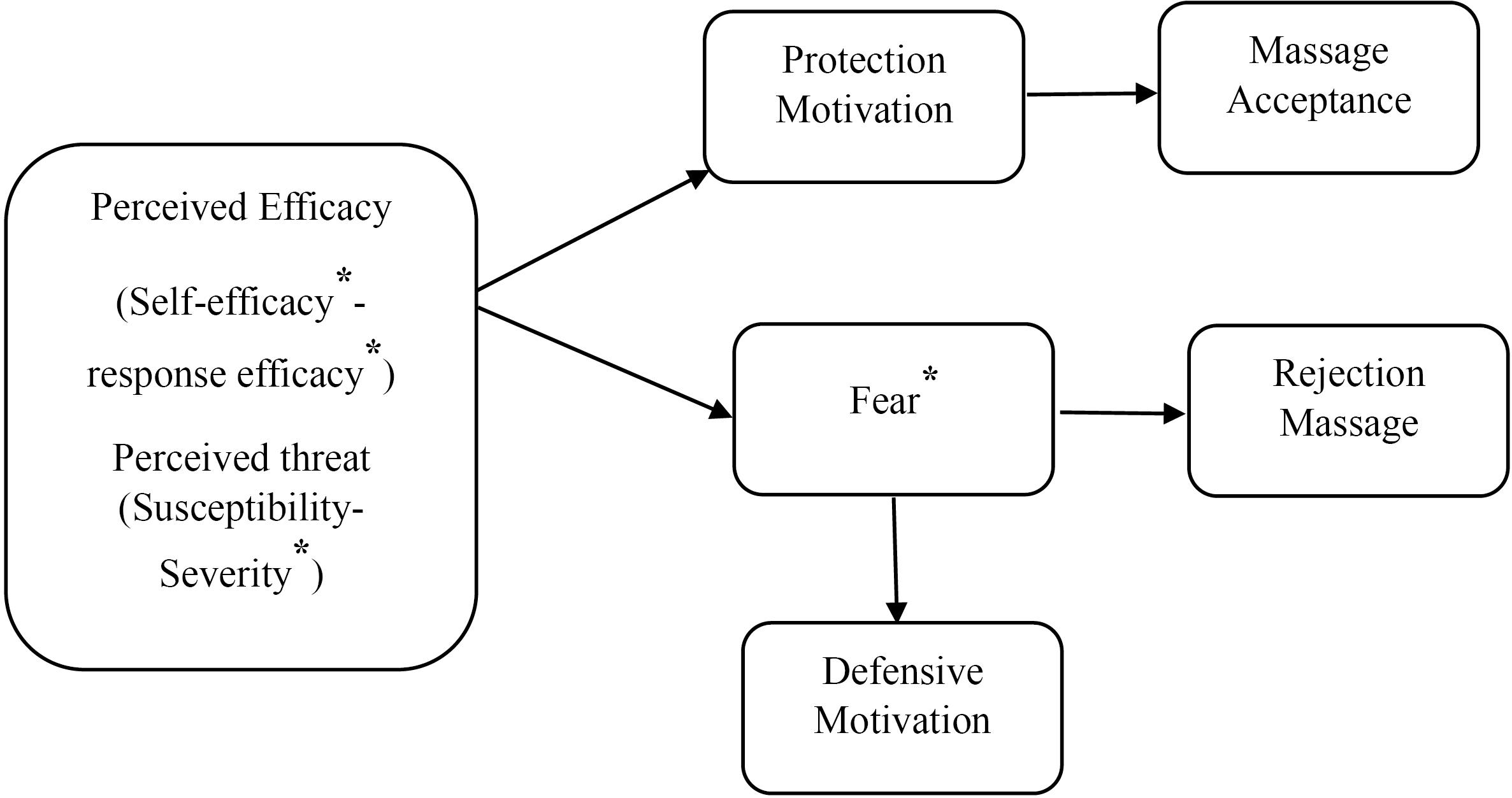
Figure 1.
The Extended Parallel Process Model Flowchart
* Predictive constructs
.
The Extended Parallel Process Model Flowchart
* Predictive constructs
Discussion
This study employed a parallel process model to examine factors influencing skin cancer prevention behaviors in individuals over 20. The results confirmed that age, gender, and education level are positively and significantly correlated with participation in preventive measures behaviors. Fear, perceived severity, effectiveness of response efficiency, and self-efficacy were predictors of skin cancer prevention intention and behavior.
According to the study, preventive behaviors were low in the target group, with only 21.8% of people always performing such behaviors. Similarly, Mazloomy Mahmoodabad et al (10), Gould et al (12), and Carley and Stratman (13) reported a similar trend regarding the low adoption of preventive behaviors among students, adults in England, and non-farmers in skin cancer, respectively.
Based on the obtained results, the most commonly adopted skin cancer prevention behaviors were visiting a doctor when suspicious symptoms were observed on the skin (67.6%), wearing long-sleeved clothes when exposed to sunlight for more than two hours (63.4%), and applying sun cream (62.2%). The findings of a study conducted by Grandahl et al (14) Danish workers revealed that 34.5% used sunscreen outdoors, 25.3% wore brimmed hats, and 4.4% wore long-sleeved shirts to protect themselves from skin cancer. In another study by Karimian Kakolaki et al (15), the most commonly adopted preventive measures were applying sunscreen cream and wearing a hat.
Some studies demonstrated that there are gender differences in intention and behavior. In the current study, it was found that women had more intention and adoption of skin cancer prevention behaviors, which is consistent with the results of a study conducted by Mazloomy Mahmoodabad et al (10). Additionally, the findings indicated that individuals at a young age had more behavioral intention to perform preventive behaviors, which is also in line with the findings of a study performed by Mazloomy Mahmoodabad et al (16).
The level of education is a crucial factor that affects the acceptance of preventive behavior in a target group. Kuter et al (17) and Chu and Liu (18) also observed that individuals with a university-level education were more likely to adopt such behavior. In other words, people with low education may be less likely to accept the behavior due to a lack of awareness and perceived sensitivity toward the consequences of the disease. To enhance risk understanding, it is recommended that researchers hold training sessions either in person or virtually.
It has been found that all constructs of EPPM theory have a positive and significant relationship with the intention to adopt preventive behaviors. Fear, perceived severity, self-efficacy, and perceived efficacy are the predictors of behavioral intention. Studies conducted by Wu et al (19), Yoon et al (20), Constant et al (21) and Sharifi et al (22), using the EPPM for coronavirus disease 19 (COVID-19), reported that self-efficacy, perceived severity, and fear in adopting prevention behaviors are effective constructs, which conforms to the results of the present study. Furthermore, the finding of Li et al (23) revealed that fear and perceived efficacy have an influential role in the adoption of colorectal cancer screening behavior. Based on the results of a study in northeastern Iran, an educational intervention based on the EPPM showed that self-efficacy, perceived efficacy, and knowledge predicted atherosclerosis prevention behavior in high school students, which corroborates the findings of the present study (22). A cluster randomized trial study aimed at preventing skin cancer in schools for adolescents demonstrated that self-efficacy was a predictor of preventive behavior (19).
Our findings confirmed that all constructs, except for defensive avoidance, had a positive and significant relationship with behavior. Fear, perceived severity, self-efficacy, and perceived efficacy were found to be predictors of adopting skin cancer prevention behaviors. Motayerzadeh et al (24) observed similar findings, indicating that people in the fear control stage perceive their efficacy as low and often view themselves as disabled in the face of illness, leading to the defensive avoidance stage. In this stage, people avoid thinking about the issue to maintain peace of mind.
In a study by Khezeli et al (25) on the adoption of preventive behaviors against COVID-19 among cancer patients, it was confirmed that fear and perceived severity were key predictors of such behaviors. It was further reported that people tend to assess the sensitivity and severity of a disease when faced with the risk factor. Understanding the severity of the disease and its potential impact can lead to an increase in fear, which can motivate individuals to take preventive measures. Therefore, it is recommended that fear be used as a motivational tool in health messages, along with emphasizing the effectiveness of such measures (26).
When individuals are confident in their abilities to adopt recommended behaviors and believe in the effectiveness of those behaviors in reducing the threat of skin cancer, they are more likely to take preventive action. This approach can help us reduce the risk factors associated with skin cancer. Therefore, it is advisable to design messages about skin cancer prevention in a way that highlights the effectiveness of adopting preventive behaviors rather than focusing on the threats posed by the disease. This approach can help individuals move toward the risk control stage and encourage them to adopt skin cancer prevention behaviors more effectively and quickly (24).
Limitations
Our study had limitations. This was a cross-sectional study, which suggests that an intervention and educational study should be designed and implemented, and a self-report questionnaire was used in this study, which could lead to data bias. Although it was attempted to reduce the deficiencies with a full description of the research issue, it is recommended that future researchers examine the participants’ behavior by observation and trial or ask them to register their protective behaviors throughout the day in future studies.
Conclusion
The findings of this study revealed that fear, self-efficacy, perceived severity, and effectiveness of perceived efficiency are important factors to consider when designing a behavioral change program based on the EPPM. Accordingly, it is advisable to prioritize these elements when preparing such programs. To increase public awareness and sensitivity, educational programs based on this model should be community-oriented and supplemented with training sessions and mass media communication. This approach could positively encourage people to adopt preventive behaviors.
Acknowledgments
The authors of this article would like to express their gratitude to the esteemed Vice-President of Research and Technology at Gonabad University of Medical Sciences for allocating the budget for this project. We also wish to thank all the individuals who collaborated and assisted in conducting the research.
Competing Interests
The authors affirm no conflict of interests in the current study.
Data Availability Statement
The datasets used and/or analyzed during the current study are available from the corresponding author upon reasonable request.
Funding
This study received financial support from the Social Development and Health Promotion Research Center, Gonabad University of Medical Sciences.
References
- Najafi A, Nadrian E, Bakri G, Nadrian H, Fathipour A. Skin cancer preventive behaviors and its determinants among high school students in Sanandaj, Iran: an application of PRECEDE model. J Educ Community Health 2017; 4(1):1-11. doi: 10.18869/acadpub.jech.4.1.1 [Crossref] [ Google Scholar]
- Roky AH, Islam MM, Ahasan AM, Mostaq MS, Mahmud MZ, Amin MN. Overview of skin cancer types and prevalence rates across continents. Cancer Pathog Ther 2025; 3(2):89-100. doi: 10.1016/j.cpt.2024.08.002 [Crossref] [ Google Scholar]
- Zareipour M, Mahmoodi H, Valizadeh R, Ghelichi Ghojogh M, Rezaie Moradali M, Zare F. Impact of an educational intervention based on the BASNEF model on skin cancer preventive behavior of college students. Asian Pac J Cancer Prev 2018; 19(10):2717-22. doi: 10.22034/apjcp.2018.19.10.2717 [Crossref] [ Google Scholar]
- Sotoudeh A, Mazloomy Mahmoodabad SS, Fattahi Ardakani M, Zareipour M, Ebrahimi H. Knowledge and practice of skin cancer prevention in sailors in southern Iran in 2019. J Mar Med 2021;2(4):237-43. [Persian].
- Nadrian H, Rahaee Z, Mazloomy Mahmoodabad SS, Bahrevar V, Khajeh Z, Najafi S, et al. Effects of educational intervention on promoting skin cancer preventive behaviors and its predisposing factors among female students in Yazd city: an application of some PRECEDE model constructs. Razi J Med Sci 2014;21(126):55-64. [Persian].
- Wolf S, Krensel M, Mohr N, Augustin M, Andrees V. Effects of workplace skin cancer screenings on preventive and risk behaviour. Z Gesundh Wiss 2022; 30(9):2243-51. doi: 10.1007/s10389-021-01670-3 [Crossref] [ Google Scholar]
- Morowati Sharifabad MA, Bonyadi F, Ebrahimzadeh Ardakani M, Falahzadeh H, Malekzadeh E. Study of sun protective behaviors for skin cancer prevention and its barriers among Kazeroon farmers. The Journal of Tolooebehdasht 2015;13(5):68-82. [Persian].
- Totzkay D, Silk KJ, Thomas BD. Evaluating the extended parallel process model’s danger control predictions in the context of dense breast notification laws. Health Commun 2022; 37(1):103-13. doi: 10.1080/10410236.2020.1824663 [Crossref] [ Google Scholar]
- Meadows CZ. The effects of fear appeals and message format on promoting skin cancer prevention behaviors among college students. Societies 2020; 10(1):21. doi: 10.3390/soc10010021 [Crossref] [ Google Scholar]
- Mazloomy Mahmoodabad SS, Gerayllo S, Khaleghi Moori M, Yoshany N. Determinants of skin cancer prevention behaviors in Yazd students: application of the extended parallel process model. The Journal of Tolooebehdasht 2020; 19(5):21-32. doi: 10.18502/tbj.v19i5.5176.[Persian] [Crossref] [ Google Scholar]
- Aliyari S, Zareiyan A, Dabagh Moghadam A, Hosseini Amiri M. The survey of obese soldiers’ knowledge, attitude, and practice about obesity management based on the extended parallel process model. J Mil Med 2018;19(6):544-50. [Persian].
- Gould M, Farrar MD, Kift R, Berry JL, Mughal MZ, Bundy C. Sunlight exposure and photoprotection behaviour of white Caucasian adolescents in the UK. J Eur Acad Dermatol Venereol 2015; 29(4):732-7. doi: 10.1111/jdv.12669 [Crossref] [ Google Scholar]
- Carley A, Stratman E. Skin cancer beliefs, knowledge, and prevention practices: a comparison of farmers and nonfarmers in a midwestern population. J Agromedicine 2015; 20(2):85-94. doi: 10.1080/1059924x.2015.1010059 [Crossref] [ Google Scholar]
- Grandahl K, Ibler KS, Laier GH, Mortensen OS. Correction to: skin cancer risk perception and sun protection behavior at work, at leisure, and on sun holidays: a survey for Danish outdoor and indoor workers. Environ Health Prev Med 2018; 23(1):59. doi: 10.1186/s12199-018-0749-5 [Crossref] [ Google Scholar]
- Karimian Kakolaki Z, Rastak L, Khadibi M, Mohammadi P. Study of the determinants of protective behavior against skin cancer based on the extended parallel process model in medical students of Shahrekord branch of Azad University in 2021: a descriptive study. J Rafsanjan Univ Med Sci 2021; 20(9):1003-16. doi: 10.52547/jrums.20.9.1003.[Persian] [Crossref] [ Google Scholar]
- Mazloomy Mahmoodabad SS, Gerayllo S, Mizani N. Factors influencing skin cancer preventive behaviors based on the extended parallel process model in Yazd medical sciences students. J Community Health Res 2019; 8(3):148-55. doi: 10.18502/jchr.v8i3.1563.[Persian] [Crossref] [ Google Scholar]
- Kuter BJ, Browne S, Momplaisir FM, Feemster KA, Shen AK, Green-McKenzie J. Perspectives on the receipt of a COVID-19 vaccine: a survey of employees in two large hospitals in Philadelphia. Vaccine 2021; 39(12):1693-700. doi: 10.1016/j.vaccine.2021.02.029 [Crossref] [ Google Scholar]
- Chu H, Liu S. Integrating health behavior theories to predict American’s intention to receive a COVID-19 vaccine. Patient Educ Couns 2021; 104(8):1878-86. doi: 10.1016/j.pec.2021.02.031 [Crossref] [ Google Scholar]
- Wu YP, Stump TK, Hay JL, Buller DB, Jensen JD, Grossman D. Protocol for a cluster-randomized trial of a schoolbased skin cancer preventive intervention for adolescents. Contemp Clin Trials 2024; 140:107494. doi: 10.1016/j.cct.2024.107494 [Crossref] [ Google Scholar]
- Yoon H, You M, Shon C. An application of the extended parallel process model to protective behaviors against COVID-19 in South Korea. PLoS One 2022; 17(3):e0261132. doi: 10.1371/journal.pone.0261132 [Crossref] [ Google Scholar]
- Constant A, Conserve DF, Gallopel-Morvan K, Raude J. Socio-cognitive factors associated with lifestyle changes in response to the COVID-19 epidemic in the general population: results from a cross-sectional study in France. Front Psychol 2020; 11:579460. doi: 10.3389/fpsyg.2020.579460 [Crossref] [ Google Scholar]
- Sharifi N, Delghandi E, Ghardashi F, Joveini Z, Hosseinzadeh A, Rahmanian V. Educational intervention based on the extended parallel process model in promoting preventive behaviors of arteriosclerosis in female high-school students. J Educ Health Promot 2025; 14:111. doi: 10.4103/jehp.jehp_1813_23 [Crossref] [ Google Scholar]
- Li SC, Lu PC, Chen SC. Emotions in fear appeals: examining college students’ attitudes and behavioural intentions towards colorectal cancer prevention in Taiwan. Health Educ J 2020; 79(5):569-82. doi: 10.1177/0017896919891749 [Crossref] [ Google Scholar]
- Motayerzadeh S, Tahmasebi R, Kavehie B, Noroozi A. Predictive power of extended parallel process model (EPPM) for acceptance of COVID-19 vaccine in residents of Bushehr province. Payavard Salamat 2022;16(3):229-40. [Persian].
- Khezeli M, Tavan A, Narimani S, Hoseini V, Zare Hosseinzadeh E, Motamedi P. Risk perception and avoidance of preventive behavior on the COVID-19 among cancer patients. Health Sci Rep 2023; 6(7):e1401. doi: 10.1002/hsr2.1401 [Crossref] [ Google Scholar]
- Reno JE, Dempsey AF. Promoting HPV vaccination among Latinx: an application of the extended parallel processing model. J Behav Med 2023; 46(1-2):324-34. doi: 10.1007/s10865-022-00293-7 [Crossref] [ Google Scholar]