J Educ Community Health. 12(3):143-150.
doi: 10.34172/jech.3487
Original Article
Why Do People Share Vaccine Misinformation on Social Media? A Psychological and Social Analysis
Arman Miri Conceptualization, Data curation, Formal analysis, Investigation, Methodology, Project administration, Software, Visualization, Writing – original draft, Writing – review & editing, 1 
Akram Karimi-Shahanjarini Conceptualization, Formal analysis, Funding acquisition, Investigation, Methodology, Project administration, Resources, Supervision, Validation, Writing – original draft, 1, 2, *
Maryam Afshari Investigation, Methodology, Project administration, Writing – review & editing, 1, 2
Leili Tapak Formal analysis, Software, 3
Saeid Bashirian Methodology, Project administration, Writing – review & editing, 1, 2
Author information:
1Department of Public Health, School of Public Health, Hamadan University of Medical Sciences, Hamadan, Iran
2Social Determinants of Health Research Center, Institute of Health Sciences and Technologies, Hamadan University of Medical Sciences, Hamadan, Iran
3Department of Biostatistics, School of Public Health, Hamadan University of Medical Sciences, Hamadan, Iran
Abstract
Background: Misinformation sharing on social media is a global concern with varying influencing factors across different societies. Understanding these factors is crucial to designing effective interventions, particularly in non-Western contexts, such as Iran.
Methods: This cross-sectional quantitative study used a crowdsourcing survey with chain referral sampling to recruit 600 adult media users in Hamadan, Iran (57.8% women and 42.2% men). A structured questionnaire adapted from validated scales assessed psychological, social, and cognitive factors. Partial least squares structural equation modeling was applied to analyze data with significance set at P<0.05.
Results: Key predictors of sharing intention included trust in government (β=0.147, P<0.001), accuracy assessment (β=-0.539, P<0.001), fear of missing out (β=0.110, P=0.003), media dependency (β=0.080, P=0.023), social comparison (β=-0.089, P=0.006), and media fatigue (β=-0.124, P=0.001). Media literacy did not moderate these relationships. Among demographic variables, only education level showed a significant effect (β=-0.12, P<0.01). The results of structural equation modeling indicated good model fit: χ2=112.5, standardized root mean square residual=0.07 (values<0.08 suggest good fit), and normed fit index=0.90 (values>0.90 are acceptable).
Conclusion: Our study revealed unique cultural drivers of health misinformation sharing in Iran, highlighting the critical roles of institutional trust and accuracy assessment. The findings emphasize the need for context-specific strategies in developing interventions to combat misinformation.
Keywords: Health information, Misleading, Social media, Coronavirus disease-19 vaccines, Developing countries
Copyright and License Information
© 2025 The Author(s); Published by Hamadan University of Medical Sciences.
This is an open-access article distributed under the terms of the Creative Commons Attribution License (
https://creativecommons.org/licenses/by/4.0), which permits unrestricted use, distribution, and reproduction in any medium, provided the original work is properly cited.
Please cite this article as follows: Miri A, Karimi-Shahanjarini A, Afshari M, Tapak L, Bashirian S. Why do people share vaccine misinformation on social media? a psychological and social analysis. J Educ Community Health. 2025; 12(3):143-150. doi:10.34172/jech.3487
Introduction
The global rise of social media has revolutionized health communication, creating unprecedented opportunities for information sharing while enabling the rapid spread of misinformation (1). During the COVID-19 pandemic, misinformation about vaccines—from exaggerated risks to conspiracy theories—was widely disseminated on platforms such as Twitter and Telegram (2,3). Such content not only distorted public perception but also reduced trust in scientific institutions, undermined vaccination campaigns, and contributed to risky health behaviors (4). Unlike conventional media, social media invites fast, personal, and conversational sharing. Users post health information not only to educate others but also to express identity, connect socially, or seek validation. These incentives can override concerns about accuracy and leave users vulnerable to emotional or misleading content. Tackling misinformation, therefore, needs something beyond algorithms and fact-checkers; it also demands an understanding of the psychological and social dynamics that influence how and why users engage (5,6).
Guided by the framework of Weiss et al (7), this study aims to examine key misinformation drivers, namely, social media trust, fear of missing out (FoMO), social comparison, fatigue, self-disclosure, and education level. In this study, the model will be extended with four empirically supported factors: government trust, accuracy evaluation capacity, perceived threat, and media literacy (8,9).
Trust-related factors play a central role. Credibility in social media, among friends, and among content creators can decrease skepticism and encourage the sharing of uncritical content (9). Similarly, trust in government plays a role in how people respond to messages from public health officials. In low-trust environments, users may reject public health guidance in favor of alternative explanations or conspiracies, while excessive trust may lead to uncritical acceptance of biased or misleading content (10,11).
Cognitive and behavioral factors, such as accuracy appraisals, are also important. Most people routinely assume that participants share misinformation for lack of reasoning, but new evidence suggests that participants are far from exclusively guided by the judgments of accuracy when deciding what to share (12). In crises, people become more dependent on social media for news and emotional regulation, increasing their exposure to misinformation—especially when fact-checking skills are weak (5).
Emotional and social factors further influence sharing behavior. FoMO may prompt users to share information quickly to remain socially relevant, without verifying its accuracy (13). Social comparison, which is exacerbated on platforms that highlight social status, can lead users to promote identity-consistent narratives–even if they are false (14,15). Additionally, self-disclosure, or the act of sharing personal views online, can cause impulsive behavior and over-sharing of emotions that avoid fact-checking (16).
Cognitive strain, including social media fatigue, interferes with deliberate decision-making. The repetition of misinformation is known to increase its perceived truthfulness, and the use of mental shortcuts, emotions, or fluency—the easier one can process the information—also creates vulnerability to misleading information (15,17,18). Moreover, perceived threat in health emergencies results in anxiety and urgency. Alarming stories may be shared so that people can avoid that behavior or feel safe doing it even if that implies anything but the truth (19).
Finally, media literacy acts as a potential ‘buffer’. It is the capacity to access, analyze, and critically evaluate media content. Users who are media literate are more alert to being manipulated by tactics like charged language or misleading imagery. Significantly, media literacy has the potential to act as a moderator of the effect of other variables (e.g., trust or FoMO) on intention to share misinformation (20).
Despite the growing body of research on misinformation, there are several important gaps in this area. First, there remains a significant geographic bias, with most studies focusing exclusively on Western contexts while neglecting important cultural dynamics, such as collectivism and institutional distrust, that characterize many non-Western settings, including Iran (21). Second, existing studies tend to examine isolated predictors (e.g., trust or FoMO) in isolation rather than developing comprehensive, integrated models that account for multiple factors simultaneously. Finally, despite the theoretical importance of media literacy in sharing information, its potential moderating role in mitigating misinformation sharing has been underexplored.
Therefore, this cross-sectional study examines the psychosocial drivers of COVID-19 vaccine misinformation sharing among Iranian Telegram users, aiming to assess how trust, cognitive-emotional factors, and threat perceptions predict sharing behavior and test whether media literacy moderates these relationships (Figure 1).
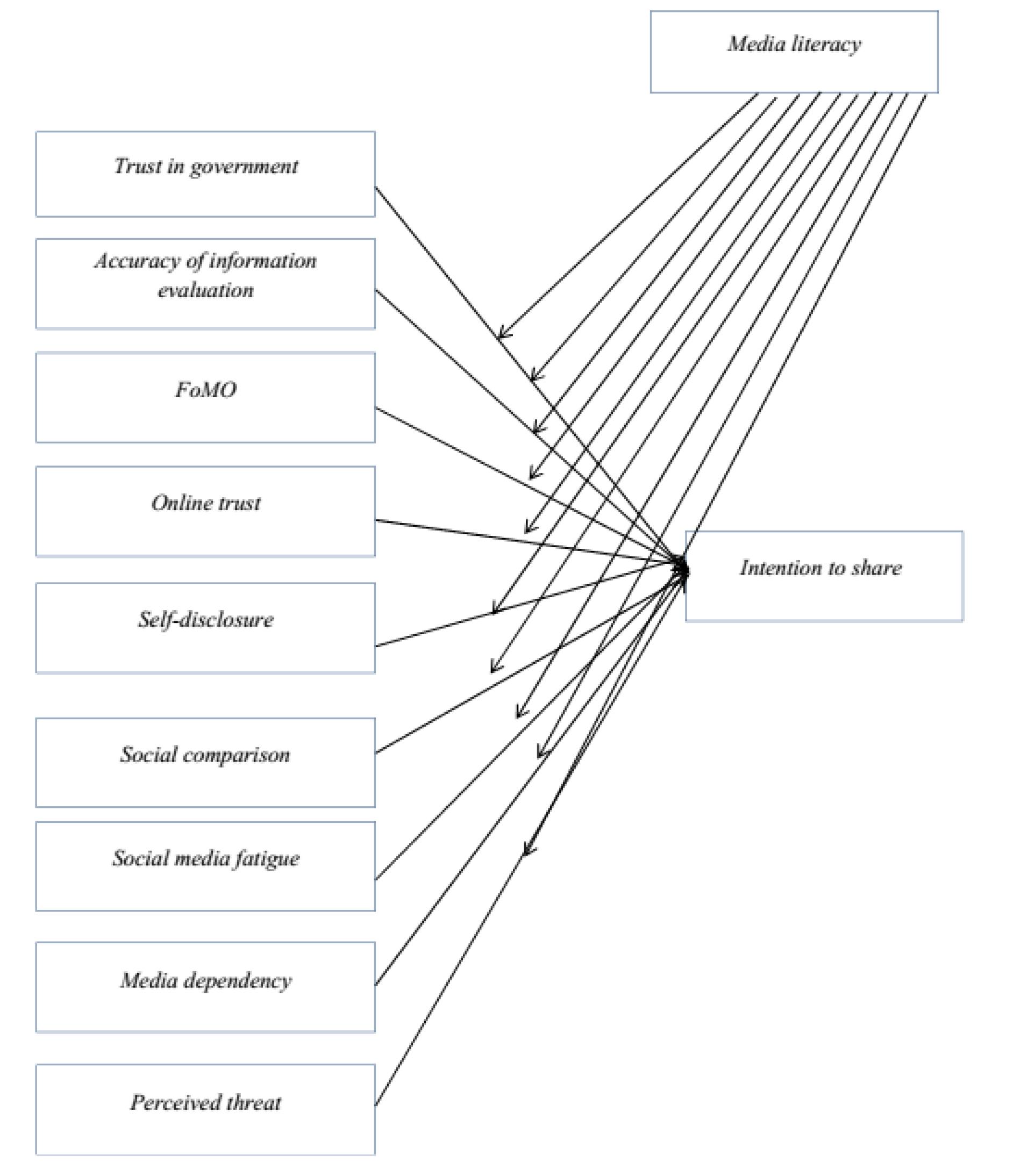
Figure 1.
Conceptual Model of the Study
.
Conceptual Model of the Study
Materials and Methods
Study Design and Participants
This study is part of a larger research project aimed at understanding factors influencing the sharing of COVID-19 vaccine misinformation on social media. The first phase of this project, which focused on the impact of message framing on information evaluation and sharing intentions, has been published elsewhere (22). The current study extends this research by examining additional psychological and social factors that influence the sharing of misinformation.
The study specifically targeted adult users of the social media platform Telegram in Hamadan, Iran. It took place during November and December 2022, a time when COVID-19 vaccination misinformation was prevalent on social media. A crowdsourcing survey was used to collect data, ensuring diverse information while upholding privacy and security standards.
The sample size was determined considering an alpha level of 0.05, a power of 0.8, an estimation error of 1.1, and a non-response rate of 20%. This resulted in a minimum sample size of about 600 participants. The data collection process and participant recruitment strategy for this study were consistent with those described in our previous work (22). Briefly, this study employed a chain referral sampling technique, along with social media announcements, to recruit participants. To this end, an advertising campaign was run on two popular local news channels on Telegram. Participants who completed the survey were asked to share the links with other eligible individuals. Using this method, 193 individuals were selected, accounting for 32% of the total 600 participants.
Measures
Misinformation refers to unintentional falsehoods, while disinformation involves intentionally spreading false information (23). As identifying the intent behind false information is a difficult task, this study aimed to explore factors influencing the sharing of both types, so the term “misinformation” was broadly used to include both intentional and unintentional instances of false information.
A questionnaire was developed by adopting or modifying existing scales from previous studies (9,15,18,24) based on our theoretical framework. The initial draft was evaluated by seven experts in health and communication to ensure content validity. In a pilot survey, the questionnaire was completed by 60 social media users, and their feedback was utilized to revise the item wording and address any potential misunderstandings. Our final instrument to measure factors influencing the sharing of COVID-19 vaccine misinformation consisted of 50 items. Online trust, perceived threat, and self-disclosure were measured with 3 items (e.g., “I trust the videos shared on social media”), 5 items (e.g., “How worried are you about getting infected with COVID-19?”), and 4 items (e.g., “I share my personal information on social media to connect better with others”), respectively. In addition, FoMO, social media fatigue, and social comparison were assessed with 3 items (e.g., “I worry that if I don’t share posts, I will lose friends and followers”), 5 items (e.g., “Using social media makes me physically tired”), and 3 items (e.g., “I compare my life with others when I’m on social media”), respectively. Moreover, social media dependency, media literacy, and trust in government were evaluated with 6 items (e.g., “I spend more time on social media than I expect”), 8 items (e.g., “When I read something about COVID-19, I compare it with other related information”), and 13 items (e.g., “I trust the Ministry of Health to control COVID-19”), respectively. All constructs were assessed using a 5-point Likert-type scale.
Participants also provided sociodemographic information, including age, gender, marital status, occupation, education level, perceived economic status, and history of COVID-19 infection.
The reliability and validity of the constructs were examined by testing indicators for composite reliability, Cronbach’s alpha, convergent validity, and discriminant validity (Tables 1 and 2). Convergent validity was assessed using the average variance extracted, which measures the amount of variance captured by a construct in relation to the variance due to measurement error.
Table 1.
Descriptive Statistics and Reliability Measures
|
Structures
|
Mean (SD)
|
Cronbach’s Alpha
|
Composite Reliability
|
AVE
|
| FoMO |
2.38 (0.87) |
0.771 |
0.775 |
0.576 |
| Media dependency |
3.05 (0.89) |
0.845 |
0.864 |
0.567 |
| Media fatigue |
2.82 (0.94) |
0.895 |
0.914 |
0.682 |
| Media literacy |
2.85 (0.37) |
0.893 |
0.706 |
0.645 |
| Media trust |
2.80 (0.86) |
0.843 |
0.902 |
0.754 |
| Perceived threat |
3.37 (0.81) |
0.726 |
0.823 |
0.507 |
| Self-disclosure |
2.85 (0.91) |
0.835 |
0.866 |
0.621 |
| Trust in government |
2.85 (0.37) |
0.975 |
0.967 |
0.691 |
| Social comparison |
2.91 (1.06) |
0.578 |
0.578 |
0.578 |
Note. SD: Standard deviation; AVE: Average variance extracted; FoMO: Fear of missing out.
Table 2.
Discriminant Validity Assessment
|
|
FoMO
|
Media Dependency
|
Media Fatigue
|
Media Literacy
|
Media Trust
|
Perceived Threat
|
Self-Disclosure
|
Trust in Government
|
Social Comparison
|
| FoMO |
|
|
|
|
|
|
|
|
|
| Media dependency |
0.235 |
|
|
|
|
|
|
|
|
| Media fatigue |
0.272 |
0.732 |
|
|
|
|
|
|
|
| Media literacy |
0.24 |
0.188 |
0.137 |
|
|
|
|
|
|
| Trust in social media |
0.315 |
0.057 |
0.055 |
0.053 |
|
|
|
|
|
| Perceived threat |
0.4 |
0.165 |
0.155 |
0.359 |
0.351 |
|
|
|
|
| Self-disclosure |
0.544 |
0.324 |
0.238 |
0.066 |
0.301 |
0.211 |
|
|
|
| Trust in government |
0.323 |
0.055 |
0.02 |
0.122 |
0.105 |
0.227 |
0.149 |
|
|
| Social comparison |
0.316 |
0.688 |
0.585 |
0.097 |
0.12 |
0.225 |
0.299 |
0.054 |
|
Note. FoMO: Fear of missing out.
Table 1 presents the descriptive statistics and reliability indices of the constructs. All constructs exhibited acceptable internal consistency. Specifically, Cronbach’s alpha values ranged from 0.726 to 0.975, exceeding the recommended threshold of 0.70, indicating satisfactory internal reliability. The composite reliability values also exceeded the commonly accepted threshold of 0.70 for all constructs, suggesting that the measurement items reliably capture the latent variables. Regarding convergent validity, average variance extracted values for all constructs were greater than 0.50, representing that more than half of the variance in the indicators was accounted for by the corresponding constructs. These results confirm that the latent constructs were adequately measured by their observed variables.
Table 2 provides the results of the discriminant validity assessment using the heterotrait–monotrait ratio. In our analysis, all heterotrait–monotrait ratio values between constructs remained below the 0.85 threshold, suggesting that the constructs are empirically distinct from each other. This supports the conclusion that each variable measures a unique aspect of the theoretical model and that multicollinearity is not a concern in the measurement model.
A compilation of eight false and eight accurate messages regarding the COVID-19 vaccine was obtained to assess the accuracy of information evaluation and the intention to share false information. These messages were chosen from two main sources: the official website of the WHO and various online media and social media platforms in Iran. The participants received an explanation of the study’s goals and research inquiries. Prior to administering the questionnaire, consent was obtained from the individuals involved in the study. Initially, participants received sociodemographic background items, and then they were asked to complete a questionnaire of factors influencing their intention to share information. Finally, 16 messages were presented in a random order, and participants were asked, “To the best of your knowledge, is the claim in the above message accurate?” (yes/no) and “Would you share this message online?” (yes/no).
Data Analysis
To validate the conceptual framework, partial least squares structural equation modeling (PLS-SEM) was employed, assessing the outer model and then the inner model. To address common method bias, Harman’s single-factor test was conducted due to the collection of single-point data. The first factor accounted for 29.8% of the total variance, below the 50% threshold, indicating no significant bias. Finally, the moderating effect of media literacy was incorporated into the model. The moderating effect of media literacy was evaluated using interaction terms in the PLS-SEM model and via bootstrapping.
Results
Descriptive Results
A total of 600 participants (347 females and 253 males) volunteered for the study (Table 3). Nearly 43.5% were aged 18–30 years old, and less than 15% were above 60 years old. The employment rate was 36.2%, while 58.7% had a university degree. Over half (53.3%) reported fair economic status (Table 3).
Table 3.
Demographic Characteristics (N = 600)
|
Characteristics
|
Frequency
|
Percent
|
| Gender |
|
|
| Male |
253 |
42.2 |
| Female |
347 |
57.8 |
| Education |
|
|
| High school or below |
104 |
17.3 |
| Diploma |
144 |
24.0 |
| Associate degree |
57 |
9.5 |
| Bachelor’s degree |
219 |
36.5 |
| Postgraduate |
76 |
12.7 |
| Age |
|
|
| 18-30 |
261 |
43.5 |
| 31-45 |
176 |
29.3 |
| 46-60 |
74 |
12.3 |
| 61-75 |
58 |
9.7 |
| > 75 |
31 |
5.2 |
| Marital status |
|
|
| Single |
281 |
46.8 |
| Marriage |
231 |
38.5 |
| Divorced |
56 |
9.3 |
| Widow |
32 |
5.3 |
| Perceived economic status |
|
|
| Excellent |
17 |
2.8 |
| Good |
117 |
19.5 |
| Fair |
320 |
53.3 |
| Poor |
146 |
24.3 |
| Employment status |
|
|
| Employed |
217 |
36.2 |
| Retired |
55 |
9.2 |
| Unemployed |
65 |
10.8 |
| Not in the labor market (student, disabled, and the like) |
263 |
43.8 |
Hypothesis Test
Table 4 summarizes the results of the structural model. The accuracy of information evaluation (β = -0.539, P < 0.001), FoMO (β = 0.110, P = 0.003), social comparison (β = -0.089, P = 0.006), media dependency (β = 0.080, P = 0.023), media fatigue (β = -0.124, P = 0.001), and trust in government (β = 0.147, P < 0.001) significantly predicted intention to share COVID-19 vaccine information. The moderating effect of media literacy was not revealed for any of the assumed relationships. Among the demographic variables, only educational level had a significant effect (β = -0.12, P < 0.01). The structural equation modeling results demonstrated good model fit: χ2 = 112.5, standardized root mean square residual = 0.07 (values < 0.08 suggest good fit), and normed fit index = 0.90 (values > 0.90 are acceptable), explaining 52.5% of variance in sharing intention (R2 = 0.525), indicating a moderate effect size (25). Moreover, the square values were > 0, which indicates that the model has good predictive relevance. Figure 2 displays a summarized and visually structured representation of the final model, as generated by the PLS software.
Table 4.
Results of the Structural Model
|
|
B
|
T Value
|
P
Value
|
Decision
|
| FoMO - > sharing intention |
0.110 |
2.24 |
0.003 |
Supported |
| Media dependency - > sharing intention |
0.080 |
2.20 |
0.023 |
Supported |
| Accuracy evaluation- > sharing intention |
-0.539 |
12.44 |
< 0.001 |
Supported |
| Media fatigue - > sharing intention |
-0.124 |
2.03 |
0.001 |
Supported |
| Trust in social media - > sharing intention |
0.032 |
0.158 |
0.316 |
Not supported |
| Perceived threat - > sharing intention |
0.014 |
0.793 |
0.713 |
Not supported |
| Self-disclosure - > sharing intention |
-0.010 |
1.66 |
0.764 |
Not supported |
| Trust in government- > sharing intention |
0.147 |
3.68 |
< 0.001 |
Supported |
| Social comparison - > sharing intention |
-0.089 |
2.18 |
0.006 |
Supported |
| Education level - > sharing intention |
-0.12 |
2.25 |
< 0.001 |
Supported |
| Gender - > sharing intention |
0.042 |
1.01 |
0.094 |
Not supported |
| Age - > sharing intention |
-0.038 |
0.87 |
0.386 |
Not supported |
| Marital status - > sharing intention |
0.025 |
0.64 |
0.521 |
Not supported |
| Perceived economic status- > sharing intention |
-0.017 |
1.58 |
0.083 |
Not supported |
| Employment status- > sharing intention |
-0.031 |
0.73 |
0.467 |
Not supported |
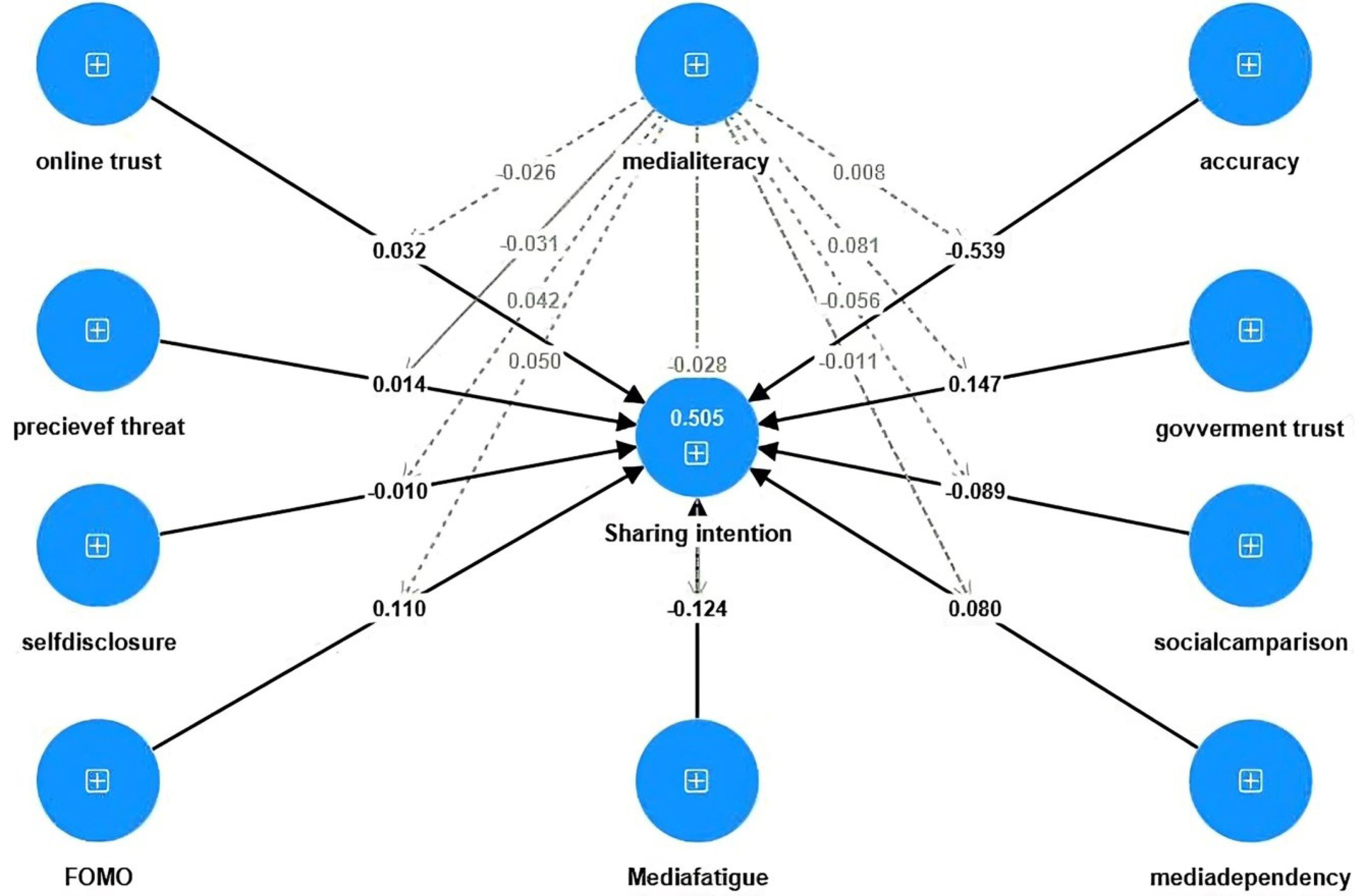
Figure 2.
Final Structural Model With Path Coefficients Obtained From PLS-SEM Analysis. Note. FoMO: Fear of missing out; PLS-SEM: Partial least squares structural equation modeling
.
Final Structural Model With Path Coefficients Obtained From PLS-SEM Analysis. Note. FoMO: Fear of missing out; PLS-SEM: Partial least squares structural equation modeling
Discussion
Our study has provided valuable insights into factors that influence the sharing of COVID-19 misinformation and can inform the development of interventions to combat the spread of false information during pandemics. The current study was conducted in Iran, a developing nation that was faced with the damaging effects of spreading misinformation during the COVID-19 pandemic. Additionally, to the best of our knowledge, this study is one of the few to examine the moderating role of media literacy in sharing misinformation. Specifically, our findings revealed that both societal (e.g., the level of trust in government) and individual (e.g., accuracy evaluation, FoMO, media dependency, social comparison, and media fatigue) factors contribute to the prediction of sharing COVID-19 vaccine misinformation.
According to some previous studies, the ability to evaluate information accuracy has been identified as a factor that influences individuals’ intention to refrain from sharing false information, which is consistent with our findings. However, recent research suggests that, in addition to the challenges of assessing accuracy, individuals’ susceptibility to misinformation plays a more significant role in information dissemination. For instance, Piksa et al (26) found that in active information sharing, the alignment of information with existing beliefs outweighs its actual accuracy.
Our study revealed a significant positive relationship between trust in government and their intention to share COVID-19 vaccine misinformation. This result is unexpected but expected within the media and political contest of Iran, in which state-affiliated actors dominate social media space. Our results demonstrated that increased trust in government could result in increased susceptibility to spreading misinformation, as individuals who trust government more will tend to perceive content with official lines as more credible in themselves, irrespective of whether it is factually true or not. This is further supplemented by the use of sharing misinformation to convey politics and allegiance to one’s group, where sharing is less about information passing but more about affirming one’s self. The modest but significant correlation between trust in government and trust in social media (r = 0.09) indirectly corroborates this reading, which can suggest such users are likely to perceive government-related social media content as particularly trustworthy. This contrasts with the findings in some Western contexts, where institutional trust was a buffer against sharing misinformation (27). The difference highlights the super-relevance of controlling for political and cultural contexts to examine misinformation dynamics.
Our study findings, in line with those of previous research (15,28), suggest that FoMO can have a positive impact on the dissemination of misinformation through social media. We propose two potential explanations for this association. Firstly, individuals who experience FoMO may feel distressed by perceiving social exclusion on social media, leading them to hastily share content without thoroughly assessing its accuracy or verifying its sources, as a means of maintaining connections and avoiding exclusion. Secondly, misinformation often possesses engaging qualities that make it captivating, and individuals experiencing FoMO may perceive a higher value in sharing such content. However, it is important to note that conflicting results have been observed in some studies, indicating that FoMO may not be a significant predictor of sharing misinformation. This highlights the need for a deeper understanding of the underlying factors that influence individuals’ responses to the relationship between FoMO and the dissemination of misinformation.
Similar to prior research, our study indicated that individuals with lower education levels were more prone to share misinformation (8). This suggests that educational backgrounds may play a role in mitigating the dissemination of false information within the intricate social media landscape.
In line with a recent study (15), our results revealed that individuals who engage in social comparison, aiming to demonstrate their knowledge and project a positive image, are more likely to exercise caution and less likely to spread misinformation. However, the results of Hu and Apuke (29) discovered a positive association between social comparison and the sharing of misinformation. This underscores the need for further research to better understand the relationship between social comparison and the dissemination of misinformation.
Similar to the findings of Wu (9), our results represented a positive correlation between dependency on social media and the dissemination of misinformation. This association can be justified by several factors. Firstly, individuals who extensively use social media may be exposed to a large volume of false information, leaving them insufficient time to evaluate its reliability or accuracy. Consequently, they are more prone to sharing information without the necessary fact-checking or verification. Secondly, social media algorithms personalize individuals’ feeds based on their past interactions and interests. People who heavily rely on social media may, therefore, be more likely to come across and spread false information that supports their preconceived notions.
The study’s findings confirmed a negative association between social media fatigue and the sharing of misinformation. This could be explained by reduced engagement with social media platforms and more selective information consumption and sharing habits. However, these results contradict those of some previous studies, highlighting the need to explore additional factors that influence the relationship between social media fatigue and the spread of false information (15,17). Recent research suggests that cognitive ability and personality traits, such as narcissism, also play a role in how social media fatigue is associated with the dissemination of misinformation (17). Accordingly, individuals with higher levels of narcissism are more likely to share misinformation when experiencing fatigue, even if they have high cognitive abilities.
Finally, we did not find evidence that media literacy moderated the study’s assumed relationships. The absence of moderation effects of media literacy may confirm the proposition that, regardless of the level of users’ media literacy, everyone is susceptible to the spread of COVID-19 misinformation. There has not been much research on the impact of media literacy on sharing health-related misinformation. In contrast, Wei et al (30) found that the effects of studied variables, including trust in social media, status-seeking, information sharing, and news-finds-me perception, were significantly stronger among users with low social media literacy. This difference may reflect the distinct effects of media literacy on the sharing of health-related misinformation versus the sharing of fake news generally.
In summary, our findings revealed that the examined factors had limited explanatory power, accounting for only 52.5% (R2 = 0.525) of the variance in the intention to share misinformation. This implies that individuals may share misinformation out of habitual behavior, potentially overlooking cognitive factors. Ceylan et al (31) reported that habits consistently emerged as the primary predictor of misinformation sharing, even when considering other factors, such as political bias and critical thinking.
Conclusion
Our results should be interpreted with caution because of the study’s limitations. First, the set of studied variables should not be viewed as a comprehensive framework but rather as an addition to previous research. Second, the typical limitations to online surveys also apply to our study. Due to the lack of a sampling frame, it was impossible to randomly select the participants, and social media users did not have the same chances of receiving the questionnaire. Third, because of the self-reported nature of data, responses may be subject to biases or inaccuracies. Fourth, the study used a cross-sectional design, which limits the ability to draw causal inferences. Additionally, technical issues, such as internet connectivity, may prevent some users from completing the survey with the collective senses.
Acknowledgements
We thank the study participants for their assistance in our study.
Competing Interests
The authors report that there are no competing interests to declare.
Ethical Approval
The study received ethical approval from the Ethics Committee of Hamadan University of Medical Sciences (Ethics No IR.UMSHA.REC.1400.864), and all participants provided written consent.
Funding
This work was supported by Hamadan University of Medical Sciences (under grant No. 14010123265) and Iran National Science Foundation (under grant No. 4006151).
Intelligence Use Disclosure
During the preparation of this manuscript, the authors utilized the generative AI tool, ChatGPT (version 4), for assistance with translation, paraphrasing, and summarization of certain sections of the text. This tool was used with the aim of enhancing the clarity and efficiency of the writing process. The authors take full responsibility for the content of the final manuscript and confirm that all interpretations, conclusions, and critical analyses are their own.
References
- Shahbazi M, Bunker D. Social media trust: fighting misinformation in the time of crisis. Int J Inf Manage 2024; 77:102780. doi: 10.1016/j.ijinfomgt.2024.102780 [Crossref] [ Google Scholar]
- Wungrath J, Nattapong A, Nuttida K. Knowledge, attitude, practice and acceptance of COVID-19 vaccine among elderly in Chiang Mai, Thailand. J Educ Community Health 2021; 8(4):245-51. doi: 10.52547/jech.8.4.245 [Crossref] [ Google Scholar]
- Allahverdipour H. Global challenge of health communication: infodemia in the coronavirus disease (COVID-19) pandemic. J Educ Community Health 2020; 7(2):65-7. doi: 10.29252/jech.7.2.65 [Crossref] [ Google Scholar]
- Kyaw TM, Al-Kurrummiah B, Varathappan N, Rathanam DT, Ravindran S, Al-Sasidharan G. Factors influencing the acceptance of COVID-19 booster dose in Malaysia. J Educ Community Health 2022; 9(2):69-79. doi: 10.34172/jech.2022.11 [Crossref] [ Google Scholar]
- Habes M, Elareshi M, Mansoori A, Pasha S, Salloum SA, Al-Rahmi WM. Factors indicating media dependency and online misinformation sharing in Jordan. Sustainability 2023; 15(2):1474. doi: 10.3390/su15021474 [Crossref] [ Google Scholar]
- Thapliyal K, Thapliyal M, Thapliyal D. Social media and health communication: a review of advantages, challenges, and best practices. In: Emerging Technologies for Health Literacy and Medical Practice. IGI Global. 2024:364-84. doi: 10.4018/979-8-3693-1214-8.ch017.
- Weiss AP, Alwan A, Garcia EP, Kirakosian AT. Toward a comprehensive model of fake news: a new approach to examine the creation and sharing of false information. Societies 2021; 11(3):82. doi: 10.3390/soc11030082 [Crossref] [ Google Scholar]
- Apuke OD, Omar B. Modelling the antecedent factors that affect online fake news sharing on COVID-19: the moderating role of fake news knowledge. Health Educ Res 2020; 35(5):490-503. doi: 10.1093/her/cyaa030 [Crossref] [ Google Scholar]
- Wu M. What drives people to share misinformation on social media during the COVID-19 pandemic: a stimulus-organism-response perspective. Int J Environ Res Public Health 2022; 19(18):11752. doi: 10.3390/ijerph191811752 [Crossref] [ Google Scholar]
- Garry J, Ford R, Johns R. Coronavirus conspiracy beliefs, mistrust, and compliance: taking measurement seriously. Psychol Med 2022; 52(14):3116-26. doi: 10.1017/s0033291720005164 [Crossref] [ Google Scholar]
- Salali GD, Uysal MS. COVID-19 vaccine hesitancy is associated with beliefs on the origin of the novel coronavirus in the UK and Turkey. Psychol Med 2022; 52(15):3750-2. doi: 10.1017/s0033291720004067 [Crossref] [ Google Scholar]
- Pennycook G, Epstein Z, Mosleh M, Arechar AA, Eckles D, Rand DG. Shifting attention to accuracy can reduce misinformation online. Nature 2021; 592(7855):590-5. doi: 10.1038/s41586-021-03344-2 [Crossref] [ Google Scholar]
- Tandon A, Dhir A, Almugren I, Alnemer GN, Mäntymäki M. Fear of missing out (FoMO) among social media users: a systematic literature review, synthesis and framework for future research. Internet Res 2021; 31(3):782-821. doi: 10.1108/intr-11-2019-0455 [Crossref] [ Google Scholar]
- Ostendorf S, Müller SM, Brand M. Neglecting long-term risks: self-disclosure on social media and its relation to individual decision-making tendencies and problematic social-networks-use. Front Psychol 2020; 11:543388. doi: 10.3389/fpsyg.2020.543388 [Crossref] [ Google Scholar]
- Talwar S, Dhir A, Kaur P, Zafar N, Alrasheedy M. Why do people share fake news? Associations between the dark side of social media use and fake news sharing behavior. J Retail Consum Serv 2019; 51:72-82. doi: 10.1016/j.jretconser.2019.05.026 [Crossref] [ Google Scholar]
- Nabity-Grover T, Cheung CMK, Thatcher JB. Inside out and outside in: how the COVID-19 pandemic affects self-disclosure on social media. Int J Inf Manage 2020; 55:102188. doi: 10.1016/j.ijinfomgt.2020.102188 [Crossref] [ Google Scholar]
- Ahmed S, Rasul ME. Examining the association between social media fatigue, cognitive ability, narcissism and misinformation sharing: cross-national evidence from eight countries. Sci Rep 2023; 13(1):15416. doi: 10.1038/s41598-023-42614-z [Crossref] [ Google Scholar]
- Islam A, Laato S, Talukder S, Sutinen E. Misinformation sharing and social media fatigue during COVID-19: an affordance and cognitive load perspective. Technol Forecast Soc Change 2020; 159:120201. doi: 10.1016/j.techfore.2020.120201 [Crossref] [ Google Scholar]
- Williams Kirkpatrick A. The spread of fake science: Lexical concreteness, proximity, misinformation sharing, and the moderating role of subjective knowledge. Public Underst Sci 2021; 30(1):55-74. doi: 10.1177/0963662520966165 [Crossref] [ Google Scholar]
- Dame Adjin-Tettey T. Combating fake news, disinformation, and misinformation: experimental evidence for media literacy education. Cogent Arts Humanit 2022; 9(1):2037229. doi: 10.1080/23311983.2022.2037229 [Crossref] [ Google Scholar]
- Sheikh MA, Mumtaz T, Sohail N, Ahmed B, Noor Z. Fake News Acceptance by Demographics and Culture on Social Media. 2021. Available from: https://mpra.ub.uni-muenchen.de/108934/.
- Miri A, Karimi-Shahanjarin A, Afshari M, Tapak L, Bashirian S. The impact of emotional vs rational message framing on social media users’ detection and sharing of misinformation: an experimental study. J Inf Commun Ethics Soc 2024; 22(3):321-30. doi: 10.1108/jices-10-2023-0124 [Crossref] [ Google Scholar]
- Søe SO. A unified account of information, misinformation, and disinformation. Synthese 2021; 198(6):5929-49. doi: 10.1007/s11229-019-02444-x [Crossref] [ Google Scholar]
- Laato S, Islam A, Islam MN, Whelan E. Why do people share misinformation during the COVID-19 pandemic? ArXiv [Preprint]. April 20, 2020. Available from: https://arxiv.org/abs/2004.09600.
- Lovakov A, Agadullina ER. Empirically derived guidelines for effect size interpretation in social psychology. Eur J Soc Psychol 2021; 51(3):485-504. doi: 10.1002/ejsp.2752 [Crossref] [ Google Scholar]
- Piksa M, Noworyta K, Gundersen AB, Kunst J, Morzy M, Piasecki J. Are we willing to share what we believe is true? Factors influencing susceptibility to fake news. Front Psychiatry 2023; 14:1165103. doi: 10.3389/fpsyt.2023.1165103 [Crossref] [ Google Scholar]
- Ognyanova K, Lazer D, Robertson RE, Wilson C. Misinformation in action: fake news exposure is linked to lower trust in media, higher trust in government when your side is in power. Harvard Kennedy School Misinformation Review 2020; 1(4):1-19. doi: 10.37016/mr-2020-024 [Crossref] [ Google Scholar]
- Apuke OD, Omar B. What drives news sharing behaviour among social media users? A relational communication model from the social capital perspective. Int Sociol 2020; 36(3):339-61. doi: 10.1177/0268580920961323 [Crossref] [ Google Scholar]
- Hu D, Apuke OD. Modeling the factors that stimulates the circulation of online misinformation in a contemporary digital age. Int J Hum Comput Interact 2024; 40(15):4132-44. doi: 10.1080/10447318.2023.2209839 [Crossref] [ Google Scholar]
- Wei L, Gong J, Xu J, Zainal Abidin NE, Apuke OD. Do social media literacy skills help in combating fake news spread? Modelling the moderating role of social media literacy skills in the relationship between rational choice factors and fake news sharing behaviour. Telemat Inform 2023; 76:101910. doi: 10.1016/j.tele.2022.101910 [Crossref] [ Google Scholar]
- Ceylan G, Anderson IA, Wood W. Sharing of misinformation is habitual, not just lazy or biased. Proc Natl Acad Sci U S A 2023; 120(4):e2216614120. doi: 10.1073/pnas.2216614120 [Crossref] [ Google Scholar]